Hospital Insurance
Facility-based care
Think inpatient and qualifying facility care.
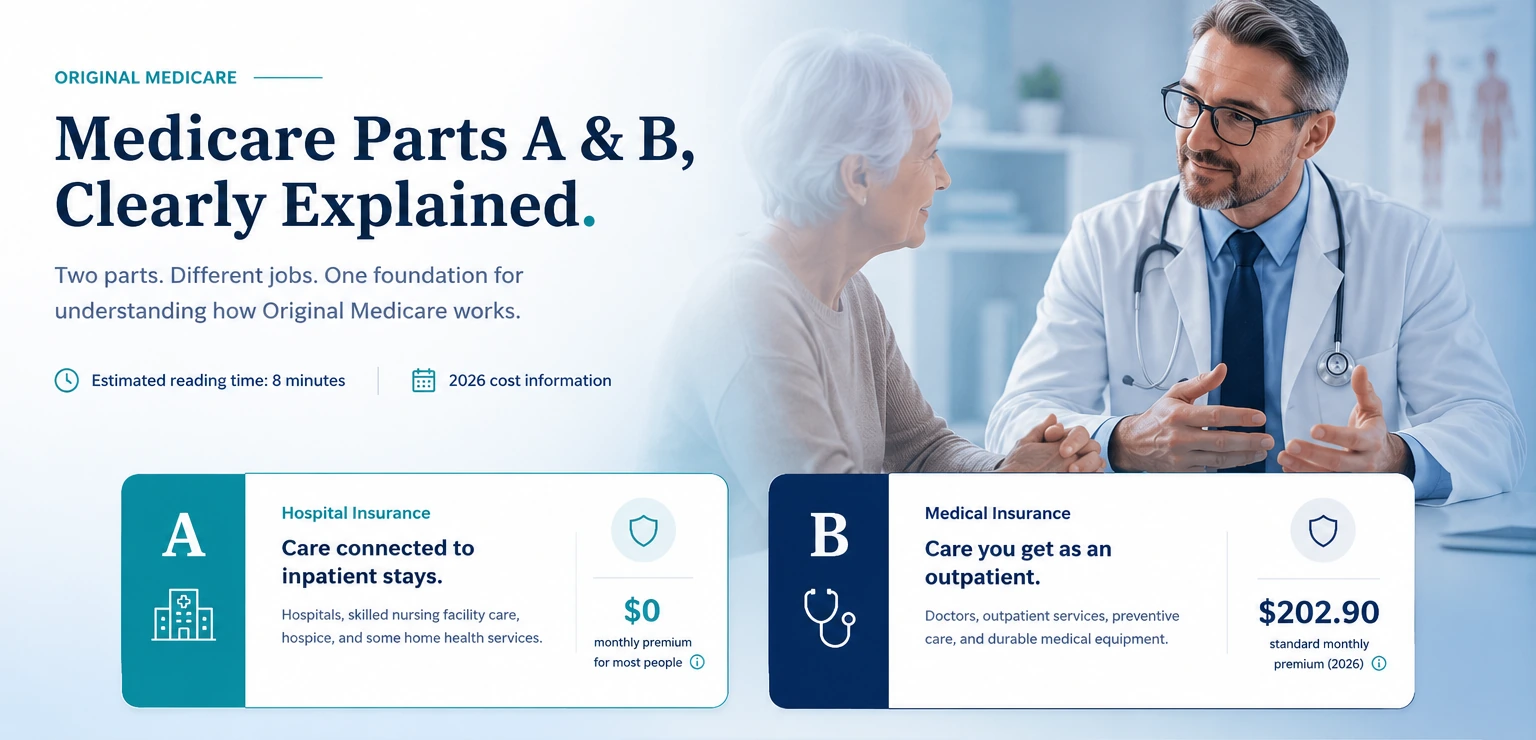
Two parts. Different jobs. One foundation for understanding how Original Medicare works.
Explore how A & B workThink inpatient and qualifying facility care.
Think medical services, tests, equipment, and outpatient care.
Part A and Part B often work together, but they cover different types of care.
It commonly applies when you are formally admitted to a hospital or qualify for certain facility and home-based services.
It commonly applies to medical services, tests, equipment, and care received without an inpatient admission.
Even at a hospital, Part A may apply when you are admitted as an inpatient, while Part B may apply when you receive outpatient or observation care. Ask: “Am I an inpatient or an outpatient?”
These examples provide a quick starting point. Coverage still depends on Medicare rules and your situation.
Select one of the care examples below to see whether Medicare Part A or Part B usually applies.
Choose any example on the left. This panel will update immediately.
Coverage may require a qualifying inpatient stay, physician certification, skilled care, or other Medicare eligibility rules.
Services generally must be medically necessary, covered by Medicare, and provided by an eligible doctor, provider, or supplier.
Accepting assignment generally means the provider agrees to accept the Medicare-approved amount as full payment for a covered service.
Medicare costs can change each year. These are the standard 2026 amounts for Original Medicare.
You or your spouse worked and paid Medicare taxes long enough, generally at least 10 years or 40 quarters.
You may qualify through a current or former spouse’s work record, or through certain disability or medical eligibility pathways. Social Security makes the final determination.
The monthly premium is $311 with 30–39 quarters of Medicare-covered work or $565 with fewer than 30 quarters. In most cases, buying Part A also requires Part B.
Hospital days 1–60: $0 daily coinsurance after the Part A deductible.
Hospital days 61–90: $434 per day.
Lifetime reserve days: $868 per day while available.
Skilled nursing days 21–100: $217 per day when covered.
An income-related monthly adjustment amount, commonly called IRMAA, may be added based on tax information Social Security receives from the IRS.
If you delay Part B without qualifying for a Special Enrollment Period, the premium may increase by 10% for each full 12-month period you could have enrolled but did not. The penalty generally lasts as long as you have Part B.
Coverage based on your or your spouse’s current employment may allow you to delay Part B without a penalty. Confirm your eligibility before postponing enrollment.
The standard Part B premium and income-adjusted amounts can change each year.
Supplemental coverage may help limit or pay some of the deductibles and coinsurance Original Medicare leaves behind.
These services are commonly misunderstood or require separate coverage.
Part D is generally used for outpatient prescription drug coverage.
Cleanings, fillings, dentures, and most routine dental services are generally not covered.
Routine eye exams for glasses and most eyewear are generally not covered.
Hearing aids and fitting exams are generally not covered.
Custodial care in a nursing home or community setting is generally not covered.
Original Medicare generally has limited coverage outside the United States.
Medicare may cover certain services when specific medical, eligibility, or treatment-related requirements are met. Always verify the exact service before receiving care.
Open each statement to reveal the clearer answer.
Most people pay no monthly Part A premium, but Part A still has deductibles and coinsurance. Some people must also pay a monthly Part A premium.
Part B covers only certain outpatient drugs in specific circumstances. Most outpatient prescriptions are handled through Medicare drug coverage.
Original Medicare does not have a yearly out-of-pocket maximum unless other coverage helps limit or pay those costs.
Coverage and costs depend on the service, provider, medical necessity, and current Medicare rules.
We do not offer every plan available in your area. Currently we represent 0 organizations which offer 0 products in your area. Please contact Medicare.gov or 1-800-MEDICARE to get information on all of your options.
Explore the developing Silver Path agent experience focused on education, onboarding, training, support, and responsible growth.